
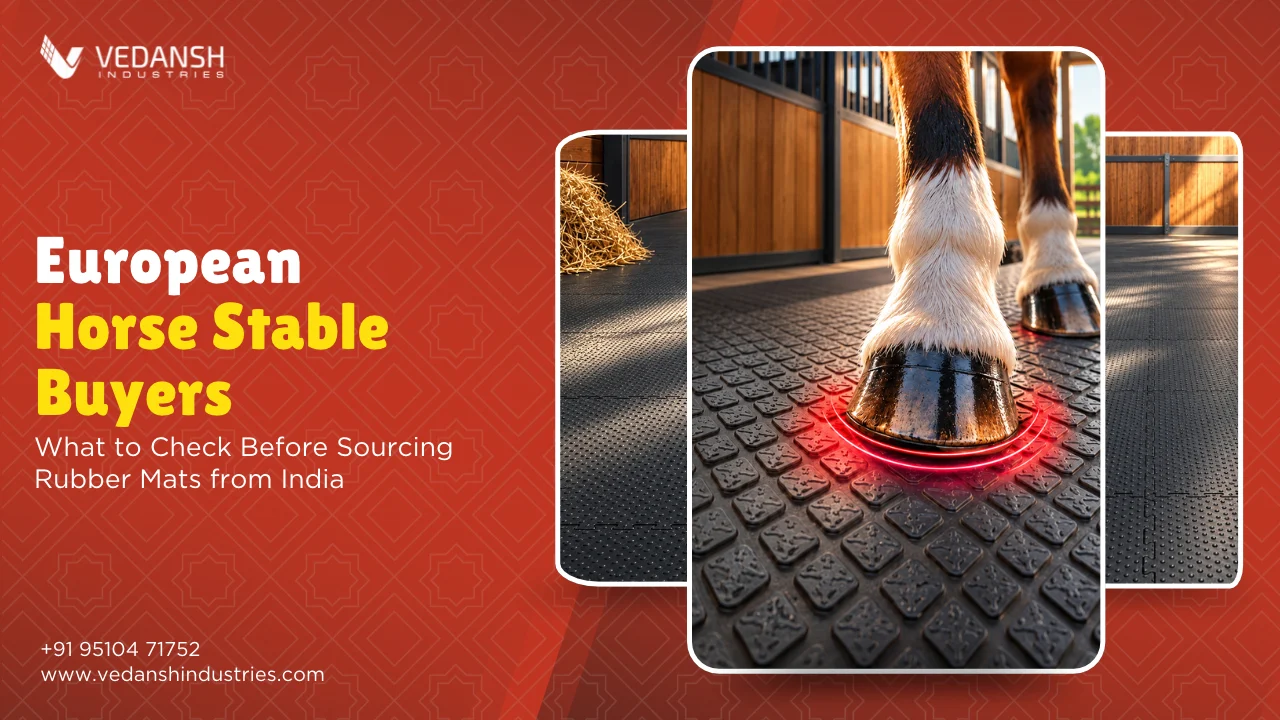
Sourcing horse stable rubber mats from another country involves more than comparing product prices. European importers, equestrian distributors and stable project buyers need to consider product specifications, stable layouts, installation requirements, packaging and delivery before confirming a bulk order.
India is one of the sourcing options for international rubber mat buyers. However, selecting the right manufacturer requires clear communication about the intended application and project requirements.
This guide explains what European buyers should prepare and verify when sourcing horse stable rubber mats from an Indian manufacturer.
1. Start with the Stable Layout and Project Requirements
Before requesting a quotation, understand where the rubber mats will be installed.
A single-horse stable, a commercial equestrian facility and a large horse farm may have different flooring requirements.
Prepare these details:
- Number of horse stalls or stable areas
- Individual stall length and width
- Total flooring area required
- Existing floor type, such as concrete or cement
- Indoor or outdoor installation
- Expected installation method
Sharing a simple floor plan or measurements with the manufacturer can help reduce sizing errors and unnecessary material requirements.
2. Define the Required Mat Specifications
Avoid requesting a quotation only for a general-purpose horse mat. Share the technical specifications needed for your project.
Important details include:
- Mat dimensions: Confirm the required length and width for each stall.
- Thickness: Specify the required thickness based on the intended application and project requirements.
- Weight: Ask for the approximate weight per mat to estimate handling and shipment requirements.
- Top surface: Confirm the preferred surface pattern and texture.
- Bottom design: Discuss whether a grooved or other bottom design is suitable for the flooring conditions.
- Edge design: Check whether straight edges or interlocking edges are required.
Request a written specification sheet from the manufacturer. This makes it easier to compare quotations from different suppliers using the same product requirements.
3. Check the Existing Floor and Moisture Conditions
The condition of the stable floor can influence the selection and installation of rubber mats.
European buyers should inform the manufacturer whether the mats will be installed over concrete, cement or another prepared surface.
Also consider:
- Whether the floor is level
- Whether water can drain away properly
- Whether moisture may collect below the mats
- Whether the stable has a suitable cleaning and maintenance routine
Do not assume that a rubber mat alone will solve drainage problems. The floor design, drainage arrangement and installation method should be evaluated together.
4. Ask for Samples Before Confirming Bulk Production
Product photographs are useful, but they cannot show every detail of a rubber mat.
Before placing a large order, request a sample or an available product piece. Evaluate it against the agreed specifications.
Check:
- Actual dimensions and thickness
- Weight consistency
- Surface texture and finish
- Bottom pattern
- Edge finishing
- Overall product condition
If the order involves multiple designs or specifications, confirm each product separately. Keep the approved sample or specification record as a reference for future repeat orders.
5. Compare Quotations on the Same Basis
A lower unit price does not always mean a lower overall sourcing cost.
When comparing Indian manufacturers, request quotations with clearly separated details:
- Product price and currency
- Mat dimensions, thickness and weight
- Minimum order quantity (MOQ)
- Customisation charges, if applicable
- Packaging details
- Production lead time
- Shipping terms and destination
Also clarify whether the quotation covers factory delivery, port delivery or delivery to the final destination. Compare the total landed cost after considering freight, insurance, customs duties, taxes and local transportation.
6. Verify Export Packaging and Shipment Planning
Rubber mats can be heavy and may require careful handling during international transportation.
Before confirming the order, ask the manufacturer how the mats will be packed, stacked and prepared for shipment.
Discuss:
- Number of mats per pallet or package
- Approximate gross weight and dimensions
- Loading arrangement
- Protection against handling damage
- Shipping method and estimated transit time
- Export documentation is required for the shipment
European importers should also confirm applicable import, product and chemical compliance requirements for their destination country with their customs or compliance advisor. Do not rely on general claims without checking the requirements relevant to the specific product.
7. Confirm Repeat-Order Consistency
For distributors and wholesale buyers, the first shipment is only one part of the supplier relationship.
Ask how the manufacturer records product specifications and manages repeat orders. Confirm whether the same dimensions, weight, design and agreed product details can be referenced for future production.
A clear product specification record helps both parties reduce confusion when ordering the same mats again.
8. Sourcing Horse Stable Rubber Mats from Vedansh Industries
Vedansh Industries is based in Morbi, Gujarat, India, and manufactures rubber mats for animal, agricultural, industrial, gym and commercial applications.
For European importers, distributors and equestrian buyers, the discussion can begin with the required stall dimensions, mat thickness, weight, surface design, bottom pattern and order quantity.
Buyers can share their project requirements to discuss available product options, customisation possibilities, bulk quantities and export arrangements.
Final Checklist Before Placing Your Order
Before confirming a bulk order, make sure you have:
- Shared the stable layout and required measurements.
- Finalised mat dimensions, thickness and weight.
- Confirmed the top surface, bottom pattern and edge design.
- Evaluated a sample against the agreed specifications.
- Compared quotations and total landed costs.
- Confirmed packaging, shipment terms and documentation.
- Discussed quality consistency for future orders.
Choosing a suitable horse stable rubber mat manufacturer in India starts with clear project requirements and proper product verification. For European buyers, these steps can make international sourcing more organised and help establish a reliable long-term supply relationship.
Contact Vedansh Industries with your required mat specifications, estimated quantity and destination country to discuss your bulk sourcing requirements.
FAQs
Share stall dimensions, required mat thickness, weight, surface design, quantity and destination country.
Customisation may be available depending on the manufacturer’s production capabilities. Confirm dimensions, thickness, design and MOQ before ordering.
Yes. Samples help buyers evaluate dimensions, thickness, weight, surface finish and overall product quality before confirming production.
Check package dimensions, gross weight, pallet arrangement, handling protection and shipment requirements.
Compare technical specifications, sample quality, MOQ, production lead time, packaging, export terms and total landed cost.